
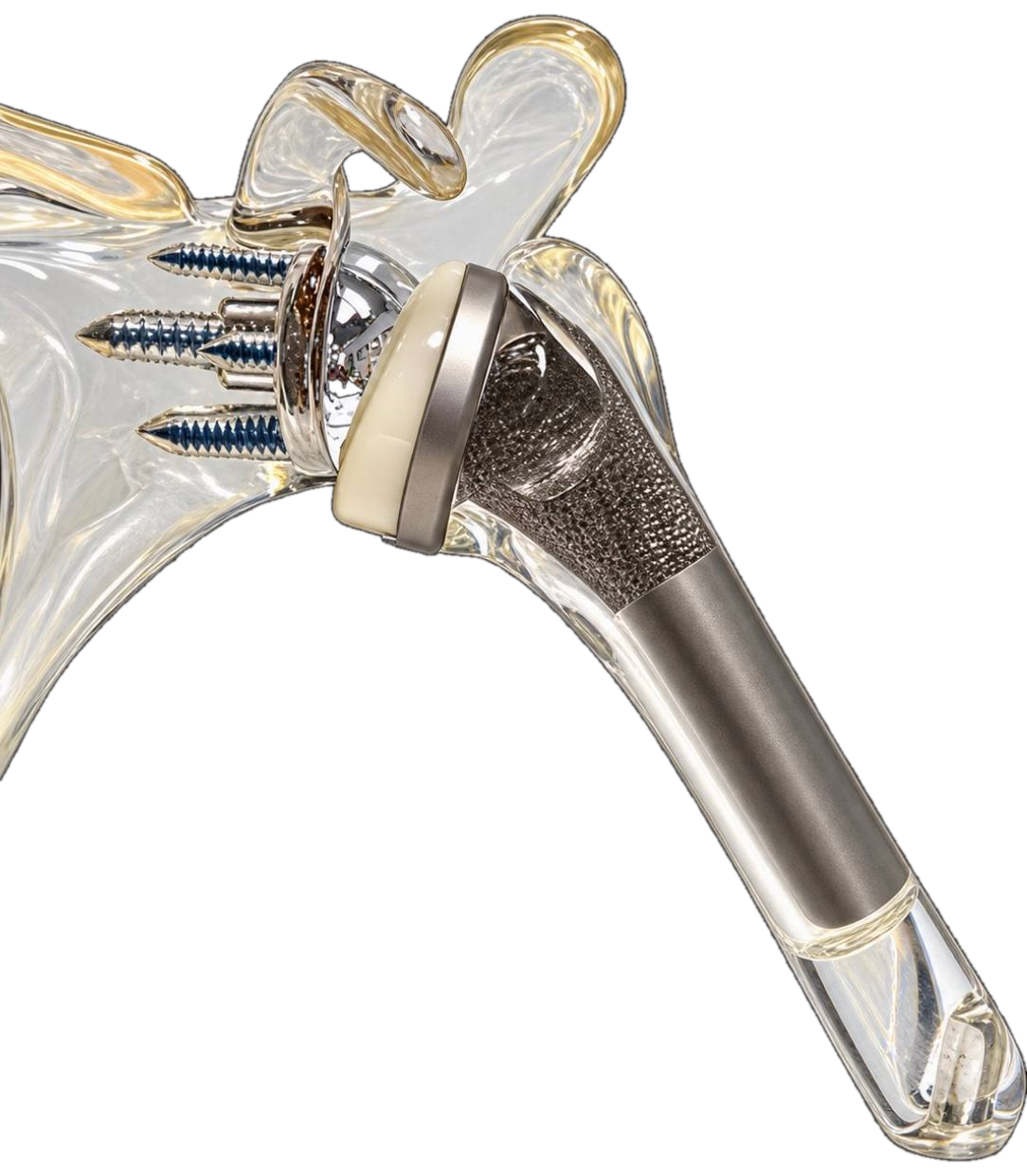
A reverse total shoulder replacement is an operation used when the normal mechanics of the shoulder can no longer be reliably restored with an anatomic replacement.
Unlike a conventional shoulder replacement, the geometry of the joint is reversed: a metal ball is placed on the glenoid and a socket is placed on the upper humerus.
This changes the biomechanics of the shoulder and allows the deltoid muscle to elevate the arm even when the rotator cuff is deficient or irreparable.
When is a reverse shoulder replacement recommended?
Common indications include:
- Rotator cuff tear arthropathy
- A massive, irreparable rotator cuff tear associated with pain and loss of function
- Advanced arthritis with significant rotator cuff dysfunction
- Selected patients with severe glenoid deformity
- Complex proximal humeral fractures in older patients
- Fracture sequelae or malunion
- Failure of a previous shoulder replacement
- Selected revision rotator cuff procedures
- Some older patients with osteoarthritis where a reverse replacement is considered more predictable because of cuff quality, glenoid morphology or other patient-specific factors
Reverse shoulder replacement has become the most frequently performed form of total shoulder replacement in Australia.
How is the operation performed?
The operation is usually performed through a deltopectoral approach.
The humeral head is removed and the glenoid is exposed. A baseplate is securely fixed to the glenoid using screws, and a metallic glenosphere is attached to create the new ball of the shoulder.
A humeral component is then inserted into the upper arm and a polyethylene socket is used to articulate with the glenosphere.
The humeral component is generally a stemmed component.
The components are positioned to restore stability, deltoid tension, range of motion and shoulder biomechanics.
Where possible and appropriate, the subscapularis tendon may also be repaired. The importance of subscapularis repair depends partly on implant design; modern lateralised reverse designs are generally inherently more stable than earlier designs. Systematic review data suggest subscapularis repair can reduce instability in some settings, although its influence is less pronounced with lateralised implants.
What result can I expect?
The principal goals of reverse shoulder replacement are:
- Relief of pain
- Restoration of the ability to elevate the arm
- Improved function and independence
- Improved sleep
- Improved shoulder stability
The majority of appropriately selected patients obtain substantial improvement.
Long-term studies extending beyond 10 years continue to demonstrate durable improvements in pain and function.
The ideal outcome is a comfortable, stable shoulder that allows the patient to comfortably reach overhead, perform personal care, dress, drive, sleep and perform normal daily activities.
A reverse shoulder replacement does not recreate a completely normal shoulder. In particular, rotation behind the back and powerful overhead activity may remain limited. Nevertheless, for a painful shoulder with major rotator cuff dysfunction, it can provide a dramatic improvement in quality of life and function.
As with all joint replacements, avoiding excessive repetitive loading and very heavy lifting helps protect the implant over the longer term.
Recovery timeline
First 2 weeks
- The arm is supported in a sling.
- Pain and swelling gradually improve.
- Hand, wrist and elbow movement is encouraged.
- Gentle shoulder exercises begin according to the postoperative rehabilitation protocol.
- The wound is usually reviewed at approximately 2 weeks.
2–6 weeks
- The sling is generally worn for approximately 6 weeks.
- Gentle passive and assisted shoulder movement progresses.
- Activities that place the shoulder at risk of dislocation are avoided.
- Lifting, pushing and pulling are restricted.
6–12 weeks
- The sling is discontinued.
- Active shoulder movement is progressively restored.
- Rehabilitation focuses on deltoid function, scapular control and range of motion.
- Strengthening begins gradually.
3–6 months
- Strength and endurance continue to improve.
- Most patients are increasingly comfortable with everyday activities.
- Functional overhead use of the arm continues to improve.
6–12 months
- Recovery commonly continues for up to 12 months.
- Strength, range of motion and confidence can continue to improve throughout this period.
Patients undergoing reverse shoulder replacement for major trauma, fracture sequelae or revision surgery may recover more slowly than patients undergoing primary surgery for arthritis or rotator cuff tear arthropathy.
Risks and possible complications
Potential complications include:
- Infection
- Bleeding or haematoma
- Stiffness
- Persistent pain
- Nerve injury
- Blood vessel injury
- Blood clots
- Anaesthetic complications
- Instability or dislocation
- Periprosthetic fracture
- Acromial or scapular-spine stress fracture
- Baseplate or implant loosening
- Polyethylene wear
- Implant failure
- Scapular notching
- Weakness or limited rotation
- Need for further surgery or revision shoulder replacement
An acromial or scapular-spine stress fracture is a complication that is relatively specific to reverse shoulder replacement. It occurs because the reverse prosthesis increases the demands placed on the deltoid muscle and its attachment to the acromion.
Instability can also occur, particularly early in recovery. Careful implant positioning, appropriate soft-tissue tension and adherence to postoperative precautions help minimise this risk.
Return to activity
Return to activity is guided by healing, shoulder control and functional recovery.
Typical timeframes are:
- Desk-based work: approximately 2–4 weeks
- Driving: usually around 6 weeks, once the sling has been discontinued and the patient can safely control the vehicle
- Light household activities: approximately 6–8 weeks
- Progressive strengthening: generally from approximately 8–12 weeks
- Gym-based exercise: usually from around 3 months, initially using low resistance
- Golf: often approximately 4–6 months
- Swimming: often approximately 3–4 months, depending on strength and movement
- Recreational racquet sports: approximately 4–6 months in appropriately selected patients
- Manual work: often 3–6 months, although heavy work may require modification
Patients can usually return to activities such as walking, cycling, swimming, golf and general gym exercise.
Very heavy lifting, repetitive overhead loading, contact sports and high-impact activities are generally discouraged.
A reverse shoulder replacement is designed primarily to provide a comfortable, functional shoulder for everyday life, rather than a shoulder capable of unlimited heavy loading.
For many patients, the most meaningful improvements are being able to sleep comfortably, reach overhead, dress independently, perform personal care and return to normal recreational activities without significant pain.