
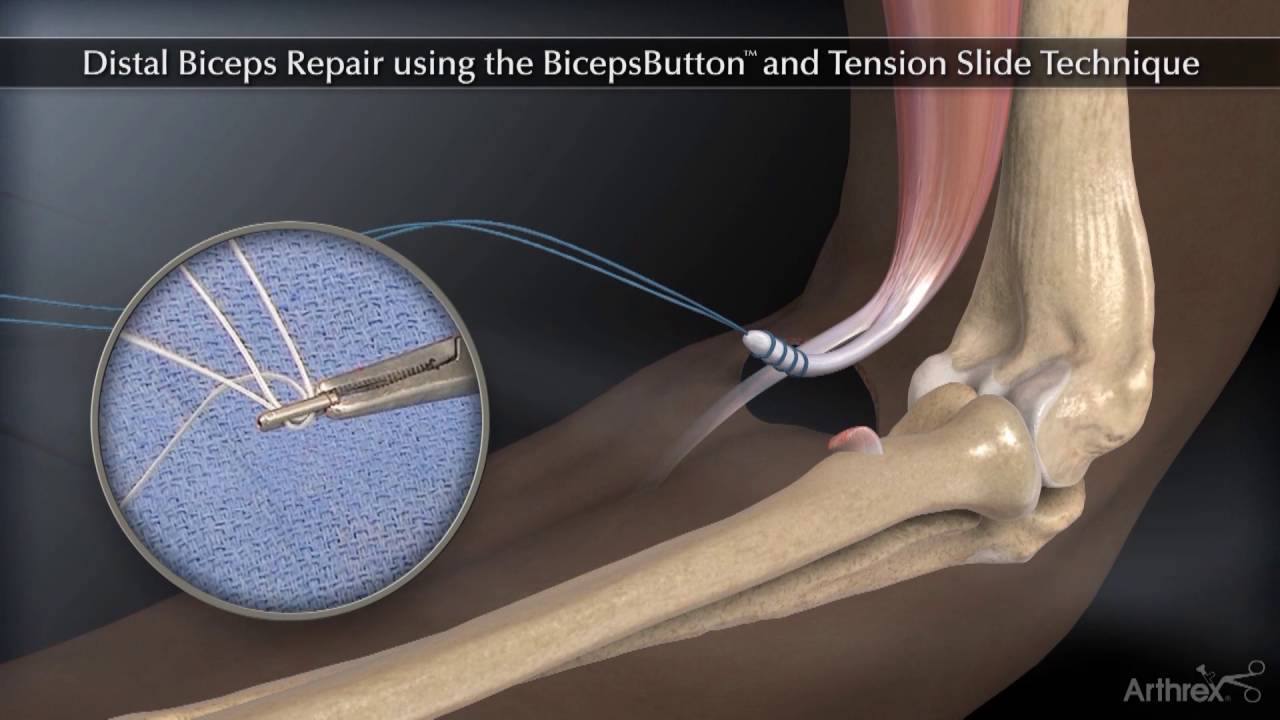
Understanding Your Injury
Pathology. The distal biceps tendon anchors the biceps muscle to the radius bone at the elbow. It usually ruptures from a single forceful eccentric load — for example, when the elbow is bent and a heavy weight suddenly extends it against resistance. It most often affects men in their 40s to 60s.
Natural history. Unlike many other tendon injuries, a ruptured distal biceps tendon does not heal back to bone on its own — the muscle retracts up the arm and scars in a shortened position. Left untreated, this causes a lasting, measurable loss of strength: studies report roughly 8-36% loss of elbow flexion strength and 21-55% loss of forearm supination strength (the twisting motion that turns the palm up), along with a cosmetic bulge higher up the arm (“Popeye” deformity). Pain typically settles over time even without surgery, but the strength deficit tends to persist.
Non-operative management. This may suit lower-demand patients, those for whom surgery carries higher risk, or those who accept the trade-off in strength, particularly given the remaining elbow flexors (brachialis, brachioradialis) provide some ongoing function. Management is activity modification, physiotherapy and accepting the strength deficit described above.
Operative management. Surgical repair reattaches the tendon to the radius, usually with a cortical button, interference screw, suture anchors, or a combination, and is generally recommended for active patients. Repair is best performed within 2-3 weeks of injury, before the tendon and muscle retract too far for a direct repair. The exercise program below is followed after this surgery.
Reference: Baker BE, Bierwagen D. Rupture of the distal tendon of the biceps brachii. Operative versus non-operative treatment. J Bone Joint Surg Am. 1985;67(3):414-417.
General Information
Wound Care: Keep your elbow and wounds clean and dry. Leave the dressings intact, unless they become soaked through with blood or fluid in which case they may be changed. When showering, cover the arm with a garbage bag taped above the dressings. Do not scrub the wounds. Your stitches should be removed 1 to 2 weeks after surgery.
Pain medication: Everybody has variable amounts of pain after surgery. It is normal to have pain for the first few weeks after surgery or injury. It is best to take regular pain medication like Panadol, and use something stronger (like Endone) only for “break-through” pain or just before exercises.
Driving: You can try driving short distances once you are off all of the strong (narcotic) pain medication. If you would like to try driving a power steering automatic (no manuals) then first take off your sling and get into the car. During the process of driving, you still need to keep movement of the operated arm to a minimum. See if you can manage the indicator, steering wheel etc, and if you feel you can, then try driving around the block once to make sure you will be able to manage the car. If you feel capable, then you can start driving short distances for convenience (up to 30 minutes per trip, 2-3 times per day). Avoid driving too much as you will find it too painful. If you don’t feel capable driving, then you can try again a few weeks later.
Swelling Control: Keep your hand and elbow elevated whenever possible. This can be achieved by resting the arm on a pillow when sleeping, or by using a sling when walking around. You must also complete the exercises on the following pages to help limit swelling.
Exercises after Surgery: Listed on the following page are a group of exercises that you are to perform over the next 6 weeks. If you are going to see a physiotherapist, then you should take this handout to the physio so that they follow my instructions. These exercises are important to minimize the amount of stiffness you will experience after your surgery / injury.
Exercises after a Distal Biceps Repair
Range of Motion Program
- All exercises to be done 4 times per day
- Perform each movement 10 times during each session.
- Hold each stretch for a count of 10 seconds
- Each time you perform your exercises try to increase the range of motion within the limits stated.
- Use pain as your guide. You should feel some discomfort with each stretch, however, it should not be severe pain.
- These exercises are important to prevent the development of a stiff upper limb.
Sling: 6 weeks
Wear the sling at all times when walking around. You can have it off when going into the shower or getting dressed, and when sleeping at night or doing exercises.
Weeks 0 to 6
A. Hand & Wrist Exercises - Begin these exercises now
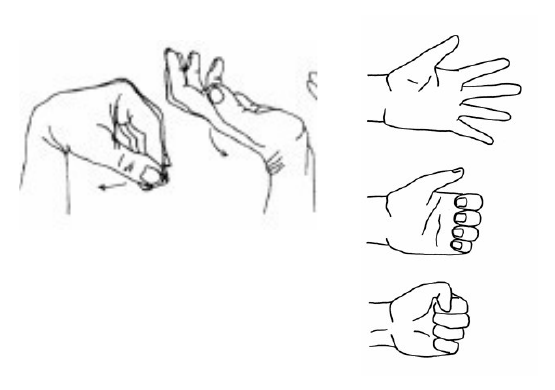
Open and close your hand by making a fist then straightening out your fingers.
Bend your wrist back and forth as if knocking on a door (keep arm at side).
B. Shoulder Exercises - Begin these exercises now
- Pendular Exercises:
- Bend at the waist.
- Let the arm hang down with the force of gravity (keep elbow bent)
- Move the arm in gentle circles as though you were stirring a pot.
- Assisted Forward Elevation:
- Raise your arm forward above your head as far as possible. You may use the other arm to help get your arm up.
Week 2
Follow up Dr Jang for a wound review at 2 weeks. Your sutures are buried and dissolvable. You will be able to leave the wound uncovered and commence showering directly onto the scar.
C. Elbow Exercises
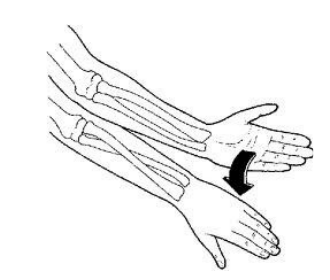
- Forearm Twisting (Supination / Pronation) 2 weeks
- With your elbow at your side and bent at a right angle, turn the palm up and then palm down as much as you can. You can use the other arm to help if needed.
Weeks 4-6
You may start to now bend your elbow.
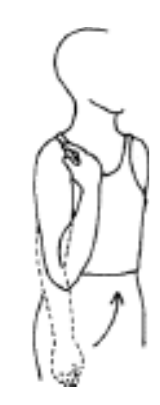
- Elbow Bending and Straightening (Flexion / Extension) 4 weeks
- Bend and straighten your elbow. You can use the other arm to help if needed. Attempt to achieve as much range as possible.
Week 6
Follow up Dr Jang for a clinical assessment to check your tendon healing and elbow range of motion
Weeks 6-12
Start gradual strengthening. Strictly no heavy lifting beyond 5kg. The tendon healing to bone generally takes 3 months to reach 80-85% strength. This is the period to see your physiotherapist and gradually build up muscle bulk and proprioception.
Week 12
Final assessment with Dr Jang with plan to continue with your physiotherapist until you’re fully recovered. Return to see Dr Jang if any concerns.
Weeks 12-16
Continue strengthening with a plan to gradually return to normal work duties. Biceps isometric exercises. Aim to commence light biceps isotonic exercises from week 16.
Weeks 16+
Criteria for return to activity include full and painless range of motion, strength within 10% of the contralateral upper extremity (which you can get assessed with your physiotherapist) and pain-free participation in activity-specific movement patterns.