How much pain will I have?
Following a proximal humerus fracture, a patient will experience a variable amount of pain. This is dependent on what type of fracture you had and whether you had surgery. You will be given a prescription for pain medication following the injury or surgery to control your pain. You should take the pain medication regularly for the first 2 days and then only when required or before physiotherapy sessions. If you feel that you are having an extraordinary amount of pain following surgery despite taking pain medication, please contact my office (numbers listed below), or the hospital at which you had your operation.
How much swelling and bruising will there be?
Following a neck of humerus fracture there will be a moderate amount of swelling in the shoulder. This is due to the injury and, if performed, the surgery itself. It is not uncommon for the swelling and bruising to travel down the arm into the forearm and hand and also into the chest. It is extremely important to remove all jewellery, especially rings on fingers- these should be left at home. To help with the swelling you should perform simple hand, wrist and elbow exercises 3 times a day for 20 minutes each time. If you feel you have an extraordinary amount of swelling or bruising following surgery, please contact me as listed above.
How much drainage and bleeding will there be if I have surgery and when can I change the dressing?
A dressing will be applied over the wound. This dressing often becomes soaked with blood. It should be changed if it is soaked through, but may otherwise be left in place. Most wounds should be dry by 7 days after surgery. If your wounds are still draining thick blood or thick yellow fluid then you should contact me or my orthopaedic registrar at the public hospital.
When can I take a bath or shower?
It is important to keep the armpit clean and dry. When cleaning the armpit, don’t lift the arm with the muscles of the shoulder. Instead, lean forward by bending at the waist and allow the operated arm to gently dangle away from the body. You can then sponge and dry the armpit.
You should not soak the wound in a bath or swimming pool for 2 weeks. You may shower or sponge bath after surgery, but you must not scrub the wounds and must try to keep them dry by keeping it covered with the waterproof dressing. You may take the sling off when in the shower and support it with the other hand. If the wounds get wet, just pat them dry with a clean towel and apply a new dressing.
How often do I need to wear the sling?
You will wear the sling only for comfort, and you can stop using it as soon as you feel your pain has settled enough. Feel free to “wean” the use of the sling i.e. take it off and put it back on intermittently until you feel you don’t need it anymore.
Can I use my arm to eat or write?
Yes. This should improve as the days pass.
How can I get comfortable to sleep?
Some patients have difficulty finding a comfortable position to sleep. When you sleep on your back it may help to place a small pillow behind the elbow or shoulder to help support the weight of the shoulder. If you sleep on your side (the operated side up) then it may help to place a pillow between your arms. You can also sleep in a reclining chair or propped up with pillows in bed. When you are getting in and out of a bed or chair, DO NOT use your operated arm to push down.
When should I return to work?
As soon as you feel able to. This depends on the type of work you do, how much pain you are in and the medications you are on, and what type of surgery you have had. In general, most patients do not work until they are seen back in the rooms or clinic at 10 to 14 days after surgery. After this, most patients are able to tolerate either single-handed work (i.e. answering the phone) or light deskwork duties only.
Who should I contact if I think I have a problem?
You should contact Dr Jang through his office during work hours on the numbers listed below or the hospital at which you had your surgery.
What is a Proximal Humerus Fracture?
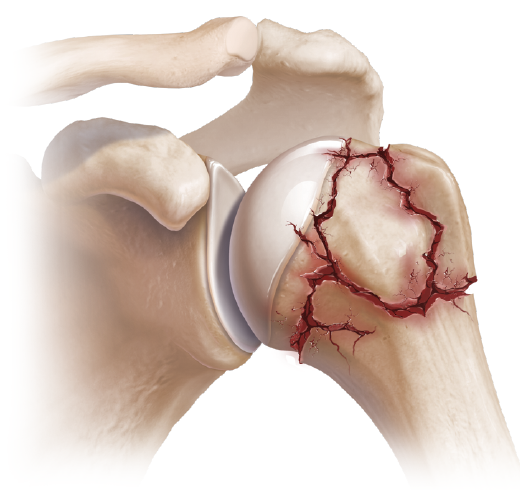
A proximal or neck of humerus fracture is a break in the upper end of the humerus (upper arm bone), near the shoulder joint. This area includes:
- The humeral head (the “ball” of the shoulder).
- The anatomical neck (just below the head).
- The surgical neck (a common fracture site, just below the tuberosities — the bony bumps where rotator cuff tendons attach).
- The greater and lesser tuberosities (areas where the rotator cuff tendons of the shoulder attach).
These fractures are common, especially in older adults with osteoporosis, often from a simple fall onto the outstretched arm or shoulder. In younger people, they usually result from higher-energy trauma.
Common Types (Neer Classification)
Fractures are often described by how many “parts” are displaced (shifted more than 1 cm or angled >45°):
- 1-part (minimally displaced): Most common (70-80% of cases). Fragments stay largely in place.
- 2-part: Often surgical neck or isolated tuberosity fractures.
- 3- or 4-part: More complex, involving multiple fragments (higher risk of complications).
Natural History (What happens without surgery)
Most proximal humerus fractures, especially minimally displaced ones, heal well with non-operative treatment:
- Healing: Bone typically unites in 6 to 12 weeks. The shoulder has excellent compensatory range of motion, so even some malunion (healing in a slightly imperfect position) often results in good function.
- Outcomes: Many patients regain near-normal shoulder function over time. Pain improves gradually; full recovery can take 6 to 12 months or longer (up to 18 months for ongoing gains). Non-union (failure to heal) is uncommon.
- In elderly patients: Low-energy fractures often do well conservatively, with sling use followed by early physiotherapy. Studies show similar long-term function compared to surgery in many cases, though some stiffness or reduced strength may persist.
Factors affecting outcome
- Bone quality, fracture displacement, patient age/activity level, and associated injuries (e.g., rotator cuff tears).
- Risks if untreated or poorly aligned: Malunion (leading to impingement or stiffness), avascular necrosis (bone death, more common in complex 3 to 4 part fractures), chronic pain, or reduced range of motion.
Typical Non-Operative Management
- Sling immobilisation for comfort (usually 4 to 6 weeks, depending on stability).
- Early pendulum exercises and physiotherapy to prevent stiffness.
- Progressive strengthening as healing allows.
Surgery (fixation with plates/screws, nailing, or replacement) is considered for significantly displaced or unstable fractures, especially in younger/active patients.
Rehab protocol: Proximal humerus Open Reduction and Internal fixation
General guidelines
Sling for comfort for 4 weeks. Can be taken off for showers.
No active abduction or external rotation for 6 weeks post operatively
No rotator cuff strengthening for 6 weeks
STAGE 1 REHAB (Weeks 0-6)
Sling for 4 weeks
Gentle shoulder pendulum exercises permitted 3 times/day.
No active abduction or external rotation
Passive shoulder range of motion: Forward flexion to 90 degrees, external rotation 30 degrees, internal rotation as tolerated.
Cervical/hand/wrist/elbow active range of motion.
At week 4 post op, you may start active assisted forward elevation to 90 degrees and commence weaning out of your sling
NOTE: If you have had your proximal humerus fracture treated non operatively, you will need to remain in the sling for a total of 4 weeks with no passive or active range of motion of the shoulder joint in that time period to allow the fracture to heal and stabilise.
Week 2: Follow up for an xray position check and wound review at clinic
Week 6: Follow up Dr Jang with repeat xray
STAGE 2 REHAB (Weeks 6-12)
Come out of sling and start active ROM exercises
Pec Minor stretching to minimize scapular protraction with flexion
Submaximal isometric rotator cuff exercises at 6 weeks
Progressive isotonic rotator cuff exercises at 8 weeks, low weights, high reps
Glenohumeral and scapular mobilisations at 8 weeks
Posterior scapular stretching at 8 weeks if needed - General upper limb strengthening at 10 weeks
STAGE 3 REHAB (Weeks 12+)
Continue upper limb strengthening
Gradual return to normal activities.
Perform these exercises immediately after your injury and operation
You may take the sling off to perform these exercises. You should go back into your sling immediately after completing your exercises.
For non operative fractures – these are your exercises for the first two to four weeks after your injury.
Wrists
Rest your forearm firmly on a table top and hang your hand over the edge of the table. Bend your wrist up and down as far as possible.
Rest your forearm firmly on table top and hang your wrist over the edge of the table. Move your wrist in circles to the right and to the left.
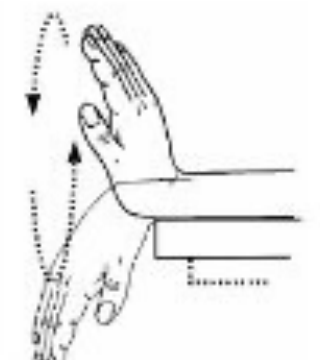
Put your forearm with your hand, palm down, on the table. Move your hand toward the little finger side. Then move the hand toward the thumb side. Keep your forearm still.
Forearms
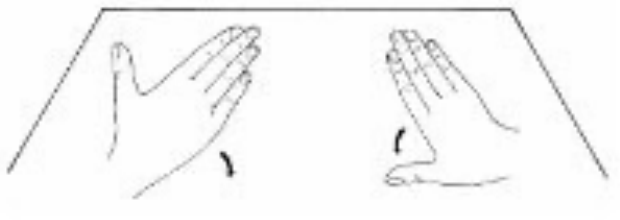
Place your arms at your side with elbows bent. Turn your hand so that the palm faces up to the ceiling. Now turn your hand so that the palm faces down to the floor, keeping your elbow tucked in at your side.
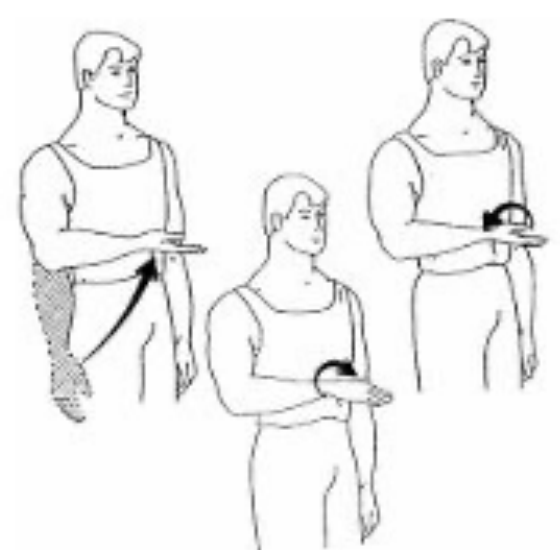
Non operative neck of humerus fracture exercises after 4-6 weeks of immobilisation
It is now time to introduce a range of motion and strengthening program together with shoulder blade exercises. It will help to have a physiotherapist or exercise physiologist to supervise your rehab. You should see the therapist once or twice each week and do the exercises 3 to 4 times per day, with the whole set of exercises taking 30 to 40 minutes.
PENDULAR EXERCISES
While bending at the waist, let the operated arm relax and swing with gravity. With the hand turned inwards, circle the arm in a clockwise direction, making the circles bigger and bigger. Perform these for 60 seconds. Then with the hand turned outwards, circle the arm in an anticlockwise direction, making the circles bigger and bigger for another 60 seconds.
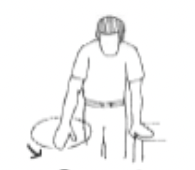
SHOULDER SHRUGS
With your arms relaxed by your side, shrug your shoulders upwards and then backwards in a circular fashion. You should perform 3 sets of 10 repetitions of this movement with a 30 second rest in between. Try to keep the other shoulder muscles relaxed.
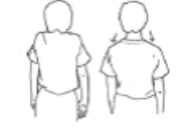
EXTERNAL ROTATION 1
With both elbows by your side and your arms bent at 90 degrees, hold a stick (e.g. cane, cut-off broom stick) between your hands. By using the good arm, gently push the operated arm outward from your body using the stick. Keep your elbow against the side of your body. When you feel the shoulder stretching out, hold this position for 30 seconds and then relax, and then repeat the exercise. It is easiest to perform this exercise lying down. As you feel more comfortable you can perform this exercise standing.
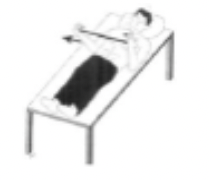
EXTERNAL ROTATION 2
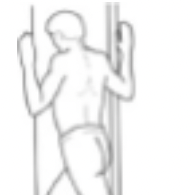
Start this exercise 9 weeks after surgery. Standing in a narrow open doorway, elbows bent and hands on the frame. Lean forward through the doorway stretching the arms backwards and outwards. Hold for 10 seconds and repeat 10 times.
FORWARD ELEVATION
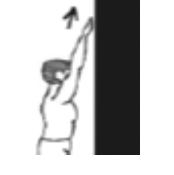
Standing one foot from the wall, walk the hand up the wall as high as possible. Lean GENTLY into the wall. Hold for 10 seconds and repeat 10 times. This is a good exercise to do in the shower with the warm water running over the shoulder.