Please commence a gentle passive stretching program for this patient who is now 6 weeks after a total shoulder replacement. A light scapular program would also be of benefit. Please avoid any increasing pain. We will start a strengthening program at the 12 week mark. I am happy for you to modify the program below depending on the progress of the patient.
For reverse total shoulder replacement patients, please don’t perform repetitive deltoid strengthening exercise programs as this increases the risk of an acromial stress fracture.
Stage 2 Exercises After a Total Shoulder Replacement
Stage 2 of your rehabilitation commences 6 weeks after surgery and continues for at least 6 weeks. During this stage the aim is to gradually restore the range of motion to your shoulder. NO STRENGTHENING exercises are commenced as yet — these will most likely begin at the 12 week mark, depending on your progress.
It would be very helpful to have the supervision of a physiotherapist during your rehabilitation, however you must also continue these exercises on your own three times a day and you should spend 30 minutes on the exercises at each session.
Understandably your shoulder will be very stiff when you first start these exercises. Take each exercise as far as you can comfortably without pain and try to make small gains each day. Do not “push through the pain”. Pushing yourself too hard can actually slow your recovery due to a rebound in the pain and stiffness.
If you need pain medication, it should be taken about 30 minutes before you start the exercise. You may find it helps to warm up first with a hot shower, heating pad or hot water bottle before you exercise.
Pendular Exercises
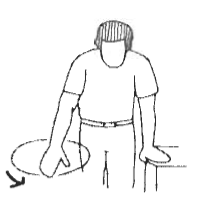
While bending at the waist, let the operated arm relax and swing with gravity. With the hand turned inwards, circle the arm in a clockwise direction, making the circles bigger and bigger. Perform these for 60 seconds. Then with the hand turned outwards, circle the arm in an anticlockwise direction, making the circles bigger and bigger for another 60 seconds.
Shoulder Shrugs
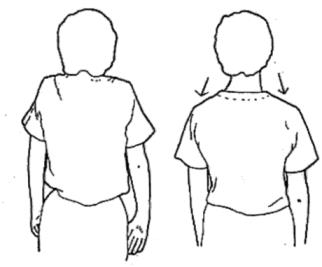
With your arms relaxed by your side, shrug your shoulders upwards and then backwards in a circular fashion. You should perform 3 sets of 10 repetitions of this movement with a 30 second rest in between. Try to keep shoulder muscles relaxed.
Forward Elevation
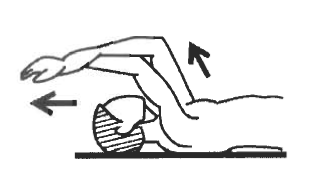
Lying on your back, clasp the operated arm’s wrist and use the good arm to pull both arms up over the head. Pull the arm as far back as you COMFORTABLY can manage and hold the arm there for 30 seconds. Repeat 10 times.
Posterior Capsular Stretches
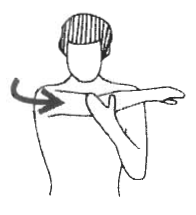
Reach across your chest towards the back of your neck with the operated arm. Grasp the elbow of the operated arm with the hand of the other arm and pull the elbow of the operated arm across the body and flat against the chest. Hold for 10 seconds and repeat 10 times.
Pulley Exercises
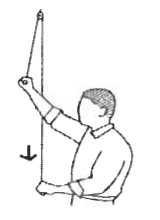
A Donovan Shoulder pulley may be purchased from my Caringbah office or online.
Stand or sit with the pulley firmly secured two feet higher than the good arm can reach overhead. You can either face the pulley or have your back towards it. Start with the operated arm down low and the other arm above. Pull down with the other arm which via the rope and pulley will lift the operated arm as far as is COMFORTABLE. Hold for 5 seconds and repeat 10 times.
External Rotation
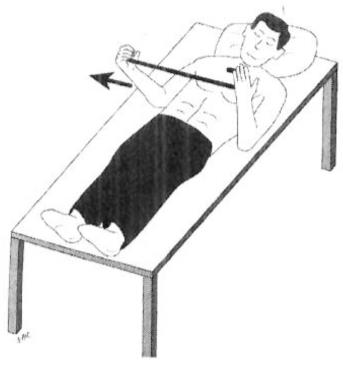
With both elbows by your side and your arms bent at 90 degrees, hold a stick (e.g. cane, cut-off broom stick) between your hands. By using the good arm, gently push the operated arm outward from your body using the stick. Keep your elbow against the side of your body. When you feel the shoulder stretching out, hold this position for 30 seconds and then relax, and then repeat the exercise. It is easiest to perform this exercise lying down. As you feel more comfortable you can perform this exercise standing.
Further guidelines for use of the arm during the 6 to 12 week period
- Carrying Restriction: 2kg
- Avoid Overhead Activities
If you have any concerns during your rehabilitation, please do not hesitate to contact my office, or send me an email: admin@drbobjang.com.au