
Triceps tendon tears/ruptures are a relatively rare injury. They occur after a sudden forceful contraction goes through the elbow. This commonly occurs in weightlifters or older men. The diagnosis of the triceps tendon rupture is pain at the back of the elbow and inability to straighten the arm against resistance. Imaging modalities such as an ultrasound or MRI can assist the surgeon to confirm the diagnosis.
These injuries are debilitating and can cause significant weakness and discomfort. A repair of the triceps tendon back to bone is required. This will take many weeks for the tendon to heal back down to bone (The tendon heals back down with ‘Sharpey’s fibres’ which take at least 3 months to get close to 80% strength).
The operative repair can be performed various ways depending on your surgeon’s preference or training. This can be done with sutures running through tunnels in your elbow bone (olecranon) or with plastic/metal anchors which are buried in your bone.
Surgery
You will receive a general anaesthetic and go to sleep for this operation. This procedure will take 60 to 90 minutes to perform. You will wake up with a long arm plaster or elbow brace locked in full extension to protect the tendon repair. Generally you will be able to go home the same day or the next morning once your pain has resolved. You will need to keep the arm dry for the next 2 weeks. Your elbow brace will need to remain on for 8 weeks. Dr Jang will guide your recovery back to full strength.
Post operative protocol
- Discharge home day 0 or day 1.
- 0 to 2 weeks: Locked at 30 degrees. Follow up clinic for a wound check.
- 2 to 4 weeks: Locked at 60 degrees
- 4 to 6 weeks: Locked at 90 degrees. Follow up Dr Jang for a clinical check.
- 6 to 8 weeks: Free range from 0 to 100 degrees
- Week 12: Follow up Dr Jang and commence strengthening.
- 6 months: return to normal activities including weight lifting.
General Information
- Wound Care: Keep your elbow and wounds clean and dry. Leave the dressings intact, unless they become soaked through with blood or fluid in which case they may be changed. When showering, cover the arm with a garbage bag taped above the dressings. Do not scrub the wounds. Your stitches should be removed 1 to 2 weeks after surgery.
- Pain medication: Everybody has variable amounts of pain after surgery. It is normal to have pain for the first few weeks after surgery or injury. It is best to take regular pain medication like Panadol, and use something stronger (like Endone) only for “break-through” pain or just before exercises.
- Driving: You should not drive a car until you have re-gained close to full use of your arm. If you do drive and are involved in an accident, you may be found liable.
- Swelling Control: Keep you hand and elbow elevated whenever possible. This can be achieved by resting the arm on a pillow when sleeping, or by using a sling when walking around. I may ask you to discard the sling to help re-gain motion as the weeks progress. You may also be given a compressive stocking (Tubigrip) that will help to minimize the swelling.
- Exercises after Surgery: Listed on the following page are a group of exercises that you are to perform over the next 6 weeks. If you are going to see a physiotherapist, then you should take this handout to the physio so that they follow my instructions. These exercises are important to minimize the amount of stiffness you will experience after your surgery / injury.
Who should I contact if I think I have a problem?
You should contact Dr Jang through his office during work hours or after hours through the hospital at which you had your surgery.
Exercises after your Triceps Repair Surgery
- ELBOW BRACE MUST REMAIN ON AT ALL TIMES
- All exercises to be done 4 times per day
- Perform each movement 10 times during each session.
- Hold each stretch for a count of 10 seconds
- Each time you perform your exercises try to increase the range of motion within the limits stated.
- Use pain as your guide. You should feel some discomfort with each stretch, however, it should not be severe pain.
- These exercises are important to prevent the development of a stiff upper limb.
Weeks 0 to 6
A. Hand & Wrist Exercises - Begin these exercises now
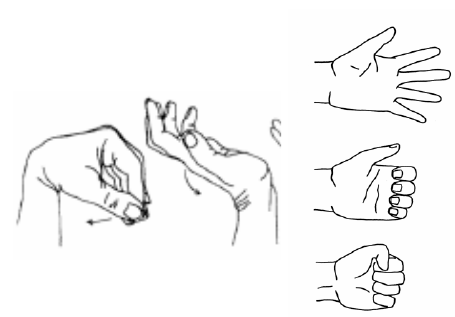
Open and close your hand by making a fist then straightening out your fingers.
Bend your wrist back and forth as if knocking on a door (keep arm at side).
B. Shoulder Exercises - Begin these exercises now
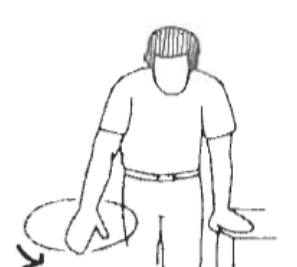
- Pendular Exercises:
- Bend at the waist.
- Let the broken arm hang down with the force of gravity.
- Move the arm in gentle circles as though you were stirring a pot.
- Assisted Forward Elevation:
- Raise your arm forward above your head as far as possible. You may use the other arm to help get your arm up.
B. Elbow Exercises
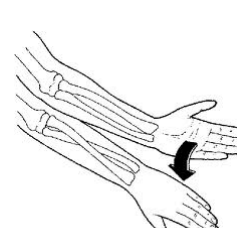
- Forearm Twisting (Supination / Pronation) 2 weeks
- With your elbow still in the brace but with the straps slightly loosened, turn the palm up and then palm down as much as you can. You can use the other arm to help if needed.
- Elbow Brace:
Must Remain on at all times - even when showering. (tape a garbage bag above the arm to keep it dry)
- 0 to 2 weeks: Locked at 30 degrees
- 2 to 4 weeks: Locked at 60 degrees
- 4 to 6 weeks: Locked at 90 degrees
- 6 to 8 weeks: Free range from 0 to 100 degrees